 RainVoid
 · the dry log
Keeping you dry is the whole job. Here is the work.
RainVoid exists for one thing: getting you where you are going without getting rained on. That is not a feature we finished. It is a job we do every single night. This page is the running log of that job: what we have built, what we are testing right now, and how the rain you report makes the next ride drier for everyone.
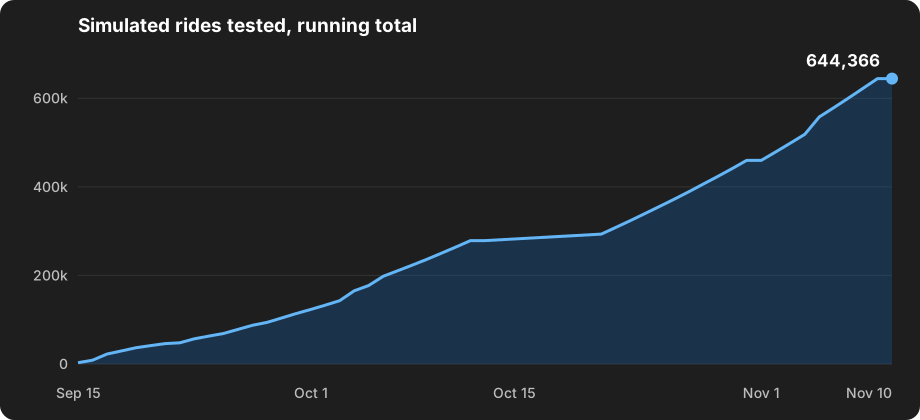
The work so far
Simulated rides through real, archived storms. Counts as of November 10, 2026.
What that work has already changed
- It tells you why. When the weather changes mid-ride, one card says in plain words what the rain is doing and what RainVoid is doing about it. No codes, no guessing.
- It acts when it should. A dry road inside your detour limit is taken for you and announced. No dry road? It heads for the nearest cover you can reach dry, or turns you back. And one tap on Keep my road hands the call back to you.
- It waits with you. Wait it out watches the radar so you do not have to, and tells you the minute your whole trip is clear, door to door.
- It knows what it does not know. Past the distance the radar can call with confidence, RainVoid says so plainly instead of dressing a guess up as a forecast.
- It keeps working when your signal does not. Ride into a dead zone and it tells you what the last radar picture showed and what to do next.
- It goes where you go. Vehicle, bike, on foot with the bus and the train, and out on the trail with a watch that says when to turn back.
- It listens. One tap on Raining? tells us the app missed something. More on that below.
What we are studying right now
A forecast that stops improving starts going stale. These are the questions on the bench today.
- How far ahead can we be sure? Every extra minute of confident forecast is an extra minute of warning for you. Each gain we find has to hold across the whole storm library, in every region, before it ships.
- What light rain does next. A patch of drizzle and a building storm are different animals. We have just finished a study across the full library on what light showers turn into, and the answer is on its way into how the app words the road ahead.
- Rain that appears from nothing. Pop-up showers are the hardest problem in short-range forecasting. We are studying the early signs, because the best reroute is the one that starts before the first drop.
- Staying dry on foot. A walker cannot outrun a cloud. We are measuring how well a dry call holds at walking pace, so the answer you get on foot is as dependable as the one you get on wheels.
- The five-minute pause. Sometimes the driest move is to pull over and let a shower cross the road ahead. We are testing exactly when that call is the right one.
- Fewer maybes. You open RainVoid for an answer. Every hedge left in the app is a place we are working to replace with a clear one, as fast as the evidence allows.
How your reports make it better
No forecast is perfect, and we would rather hear about a miss than hide it.
- Tap Raining? when rain reaches you that the app did not call. If the radar picture missed it, the app says sorry, and it means it.
- Your report becomes a test. With anonymous reports switched on, that moment joins the work: the time, the place to about a kilometre, what you saw and what the radar showed. No name, no route, no account.
- A miss is never shrugged off. It is studied, and what we learn has to prove itself against hundreds of real storms before it reaches your phone.
Where this is going
We do not control the sky, and we will never say we do. What we control is the work. Every miss gets studied. Every change is tested against hundreds of real storms before it ships. And this page will keep showing what we have done and what comes next, so you can see the work for yourself.
RainVoid Futurecast is our own forecast, built on public radar data from NOAA. Every accuracy figure on this site comes from simulated rides through real, archived storms, with its date beside it.